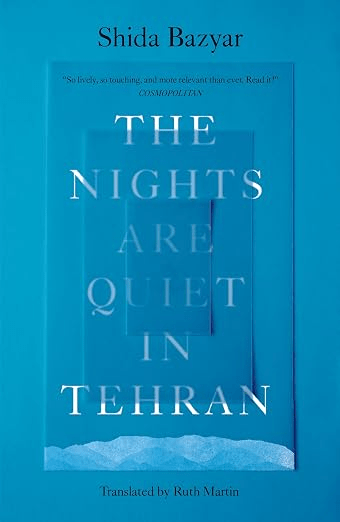
1979 – “What actually happens after a revolution? I could ask, though we’ve answered that too many times already…: class struggle, radical change in the institutions, a dictatorship of the proletariat. But actually, Sohrab and I have just spent the last few days walking around prisons and universities… and actually every program is now full of Ayatollah Khomeini… What actually, really happens after a revolution is something I’ve never heard anyone ask out loud.” – The Nights Are Quiet in Tehran by Shida Bazyar
When it comes to revolutions starting with such promise and ending so badly, the Iranian overthrow of the Shah in 1979 ranks right up there with the French and Russian Revolutions. In all three cases, a brutal dictatorship took over which exists in Iran to this day. And that is the subject of The Nights Are Quiet in Tehran (2025) by Shida Bazyar, shortlisted for this year’s International Booker Prize.
It is 1979 and Behzad, who narrates the first part of The Nights Are Quiet in Tehran, is a young teacher and a communist organizer living in Iran. Along with his friends and comrades, he took part in the revolution. And Behzad, like most Iranians, is full of hope now that the Shah’s dictatorship is over. But with the return of the Ayatollah Khomeini from exile, things start moving fast, and we leave Behzad’s 1979 section of the book knowing that he and his fiancée Nahid will not be able to remain in Iran for much longer.
The remaining three parts of The Nights Are Quiet in Tehran are set in Germany, where Behzad and his family have moved. Part two of the novel, 1989, is narrated by Behzad’s wife Nahid. Parts 3 and 4 are narrated by their children, Laleh (1999) and her younger brother Mo (2009).
And the problem for me is that I really liked part one of this novel set in 1979 and narrated by Behzad. Granted, 1979—when Iran was in the midst of a revolution—is going to be more interesting to read about. And Behzad is an interesting character: smart, full of optimism and plans. But in parts 2, 3, and 4, Behzad’s family takes over the narration about what it’s like to live in exile. And I do feel for Nahid, who never wanted to leave her homeland and her parents. Behzad is also having trouble assimilating. The fire has gone out of both of them, and they spend their nights listening to the news from Iran and worrying about their friends who stayed behind and have not been heard from.
But my patience ran out when Laleh’s story takes over. There is no spark of life in her, which I could accept more from her mother, but Laleh was 4 when she left Iran, so this quiet pining for a homeland she doesn’t remember got on my nerves. And Mo, who narrates the 2009 section of the novel, didn’t save the book for me.
I can’t recommend The Nights Are Quiet in Tehran, but if you want a book that deals with the same themes of a revolution turning on its people and what it’s like to live in exile, My Friends by Hisam Matar (also a Booker Prize nominee) is the way to go.


Leave a comment