“I sit at my desk …. I can’t just tell jokes any more, I need to tell a story of some sort. Once I have a theme, I will be the sort of comedian who is invited on literary podcasts to talk about my favourite books and asked to host radio documentaries about the Culture Wars …. When people write reviews pooh-poohing my work, it will be because it is so challenging and confrontational and a bit inaccessible to the masses, not because I look like a pasty in a flannel shirt. The theme will protect me. I turn to the most recent page of thoughts to see if I landed on anything.” – Dolly Alderton, Good Material
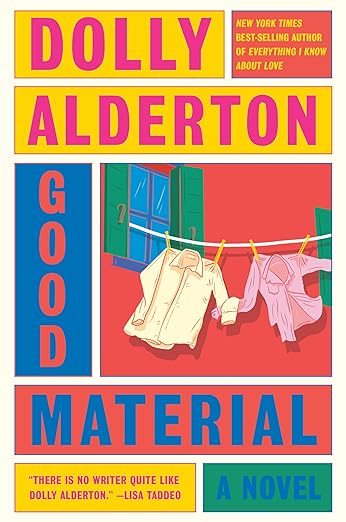
The critically acclaimed and bestselling novel Good Material (2023) by Dolly Alderton has been described as a romantic comedy. But is it? I would say the novel more accurately falls under the literary fiction genre, and very good literary fiction at that. Romantic comedies (rom-coms) usually end in a happy place, and Good Material is much more open-ended when it comes to the future of our protagonists and in my opinion more realistic.
Good Material begins in 2019, where we are introduced to Andy Dawson, a 35-year-old struggling comedian living in London. Andy supports himself by doing his comedy routine for weddings, department store openings, and corporate conventions, and it barely pays the rent. Andy’s romantic life is also in shambles. His four-year relationship with his girlfriend, Jen Bennett, ended a few months back and he is trying to figure out why she left. Jen was vague about that.
Andy cannot move on, and in many ways he is an unreliable narrator. His real worry should not be why Jen left him, but why, after years working the comedy circuit, he is living paycheck to paycheck with no recognition or a savings account. The reader can see this, but Andy not as much. And so, instead, he focuses on the breakup and what went wrong.
How readers feel about Good Material will probably hinge on how they feel about Andy. Some may see him as a bit of a whiner, and Andy does engage in a fair amount of self-pity. But I never got tired of Andy. He’s well-drawn, funny, and kept my interest. And when Andy starts seeing a personal trainer and eating Greek yogurt and canned tuna instead of taco chips and beer, I had hope that he was getting his life together. I began seeing Good Material as the story of how a protagonist who starts out in a bad place can slowly change their life for the better. I find those novels inspiring.
But the last 40 pages of Good Material upend everything we thought we knew about where Dolly Alderton was taking us. Andy narrates most of the novel. We see everything through his eyes. But in the last 40 pages of Good Material, the first-person narrator switches to Jen. I can’t go into Jen’s side of the story without giving too much away, but suffice it to say the breakup was never about Andy. And it’s during these last 40 pages that Good Material goes from a routine breakup novel to something much more profound and worthy of all the critical praise it has received.


Leave a Reply