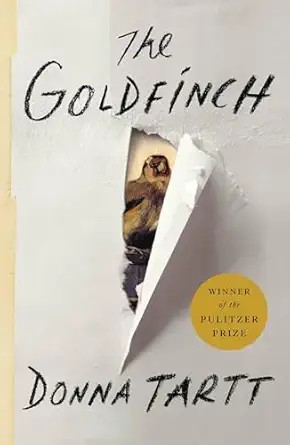
“Who knows why Fabritius painted the goldfinch at all? A tiny, stand-alone masterpiece, unique of all its kind? … Why this subject? A lonely pet bird? … Why does it seem so significant to me that the wall is plain—no tapestry or hunting horns, no stage decoration—and that he took such care to inscribe his name and the year with such prominence, since he can hardly have known (or did he?) that 1654, the year he made the painting, would also be the year of his death? There’s a shiver of premonition about it somehow, as if perhaps he had an intimation that this tiny mysterious piece would be one of the very few works to outlive him?” – Donna Tartt, The Goldfinch
I knew I wanted to read Donna Tartt’s The Secret History (2003), a novel in which a group of grad students commit a crime, cover it up, and are haunted by that crime for years. What’s not to love? But every time I would click on Libby, the wait for The Secret History was many weeks long and I didn’t have the patience.
I knew that Donna Tartt had also written The Goldfinch, winner of the 2014 Pulitzer Prize. I had vague notions of what the novel would be about: an 800-page book told from the point of view of a young boy, and somehow a bird was involved. I didn’t see myself reading it. But three weeks ago, The Goldfinch was ready to borrow from Libby in audio and ebook form. I figured, okay, I’ll give it a try. I can always DNF. Well, I have now finished The Goldfinch, and this novel is incredible and not at all what I thought it was going to be about.
The Goldfinch is narrated by 27-year-old Theo Decker. And when we first meet Theo, he is living in a hotel room in Amsterdam looking back on his life. It’s a life defined and shattered by a traumatic event that happened to him when he was 13.
On that fateful day, Theo and his mother were at the Museum of Art in Manhattan in the room where Fabritius’ masterpiece, The Goldfinch, and other priceless works of art were being shown. Theo’s mother particularly wanted to see the Goldfinch, a favorite painting of hers since she was a child. Theo would rather get something to eat, but he notices an elderly gentleman, Mr. Welty, and a young girl, Pippa, who he briefly talks with. Theo’s mother is in another room viewing other paintings, and then an explosion happens at the museum—a terrorist attack.
Theo is shell-shocked and desperate to find his mother. He sees the dying Mr. Welty on the ground. In the explosion, the goldfinch portrait blew out of its frame. Mr. Welty, holding the painting, gives it to 13-year-old Theo, pleading with him to keep it safe. Theo, injured, takes the Goldfinch and, staggering out of the museum room, frantically searches for his mother. But she was killed in the explosion along with many others.
We then go on a fourteen-year journey with Theo: foster homes, living with his troubled father in Las Vegas where he meets Boris (who is no Boy Scout but will turn out to be a great friend), and college. Theo ends up working for Hobie, who owns an antique shop in Manhattan where he restores and sells valuable old furniture. Hobie was the co-owner of the shop when the deceased Mr. Welty was alive. Hobie is a kind and good man and teaches Theo the trade.
But despite this chance at a new life, things are not going well for Theo. He drinks and takes opioids to get through the day. He suffers from PTSD. And above all, there is the priceless Goldfinch painting that he still has possession of into his 20s. Theo could have returned it at age 13 or 14 and there would have been no problem. But his life was in such chaos he couldn’t focus, and the painting kept him close to his mother. Now, at 27, it’s a stolen object. How to return it to the art world without implicating himself?
Theo also begins to learn about Carel Fabritius (1622–1654), the artist who painted the goldfinch. Fabritius was a gifted painter who studied under Rembrandt, and he was living in the Dutch city of Delft in 1654 when a gunpowder factory exploded, killing over 100 people, including Carel Fabritius, and destroying all but a handful of his paintings. I had no idea about this true story, and when Theo learns this, it becomes essential for him to return the Goldfinch to the art world by whatever means necessary.
Donna Tartt, I believe, is a writer who comes along once in a generation. The Goldfinch is not perfect, and with an 800-page novel you do have to pace yourself. I did go through sections where I felt the story was dragging a bit, but not for long. There is a beautiful and seamless quality to Tartt’s writing. I never lost interest in Theo as he tells us his story and the audio reader David Pittu is excellent.
The Goldfinch is a five-star novel for me, no question, and quite possibly the best book I’ll read this year.


Leave a Reply