“John Barton was not far wrong in his idea that the Messrs. Carson would not be over much grieved for the consequences of the fire in their mill. They were well insured… It was a pleasant thing to be able to lounge over breakfast with a review or newspaper in hand .. There is another side to the picture. There were homes over which Carsons’ fire threw a deep, terrible gloom… the homes of those to whom leisure was a curse. There, the family music was hungry wails, when week after week passed by, and there was no work to be had, and consequently no wages to pay for the bread the children cried aloud for…” – Elizabeth Gaskell, Mary Barton
If you are new to Elizabeth Gaskell, many will recommend North and South (1855). But though I was excited by the Pride and Prejudice premise of North and South, I came away somewhat disappointed. To make a long story short, there is only one Mr. Darcy and John Thornton, the Manchester mill owner, is no substitute.
And so instead of North and South, I would recommend readers begin with Elizabeth Gaskell’s first novel, Mary Barton (1848). It’s one of the best classics I’ve read, and I’ve read my share of classics. And in addition to the wonderful writing, Mary Barton taught me a lot about the Industrial Revolution taking place in Manchester during the 1840s. The anger and mistrust between mill owners (Masters) and their workers was a powder keg.
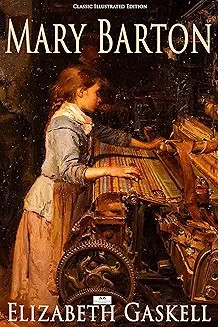
As for the novel, Mary Barton is the beautiful daughter of John Barton, who works in a cotton mill factory owned by the Carson family. Mary works in a dress shop. John and Mary get by, but when there is a fire at the mill and it shuts down, John is out of work and his trade union activities make it impossible for him to get work elsewhere. Mary is a good daughter working long hours at the dress shop, but her unemployed father is getting angrier and more depressed.
Meanwhile, Mary has caught the eye of the mill owner’s son, Henry Carson. She has dreams of becoming Henry’s wife. Henry is a spoiled young man used to getting what he wants. Henry has no intention of marrying Mary. He wants her as his mistress. Jem Wilson, who worked with Mary’s father in the mills, is also smitten with Mary, and his love is genuine. And then Henry Carson is murdered. And so Mary Barton is not only a romance novel. It’s a mystery.
Elizabeth Gaskell was the wife of a prominent Unitarian minister in Manchester, and when Mary Barton was published it caused an uproar. But Gaskell was no firebrand. What I have noticed in her novels North and South, My Lady Ludlow, and Mary Barton is that Gaskell’s hope was to lessen the divide between the upper and lower classes, the rich and the poor. It was Elizabeth Gaskell’s hope, I think, that both sides would let down their guard a bit and listen to each other.
Religion and faith also play an important part in Mary Barton, as they did in Gaskell’s life. It’s not fire and brimstone, but rather the religion of God’s love, forgiveness, and redemption. It’s one of those novels where everyone gets a decent ending and it’s not sappy or far-fetched. One of the best books I will read this year.


Leave a comment