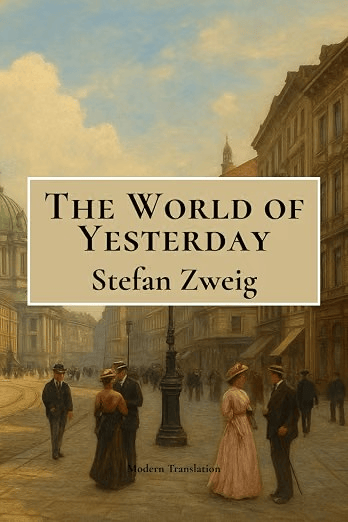
“When I try to find a fitting phrase for the time before the First World War, the years in which I grew up, I think the most accurate would be to call it the Golden Age of Security. Everything in our nearly thousand-year-old Austrian monarchy seemed built to last, and the state itself stood as the highest guarantor of that permanence… Vienna, as everyone knows, was a city of pleasure; but what is culture, after all, if not the art of coaxing from life’s rough material its finest, most delicate, most refined essence through love and artistry?” – Stefan Zweig, The World Of Yesterday
I had never heard of the writer Stefan Zweig until fairly recently. He was born in Vienna into an Austrian-Jewish family in 1881, and during the 1920s and 1930s his novels, poems, and biographies were translated widely. Today he is best known for his memoir The World of Yesterday (1943), published shortly after his death in 1942.
Zweig tells us that it had never been his intention to write his life story. But history overtook him, and between 1881 and the 1940s, the Vienna he loved changed in ways he could never have imagined. It’s a cautionary tale for our times as well.
The World of Yesterday is divided into three sections. The first half of the book deals with Zweig’s early life in Vienna before World War I, a lost world of art, music, and poetry. And then there were the cafés where Stefan and his classmates spent a lot of time:
“The Viennese café was a very special kind of institution, unlike anything else in the world. It was, in fact, a kind of democratic club, open to anyone for the price of a single cup of coffee, where one could sit for hours… And since, with childish vanity and a kind of sporting rivalry, we were constantly trying to outdo each other in knowing the newest and the very newest, we lived in a state of permanent jealousy over discoveries.”
In The World of Yesterday, Stefan Zweig writes about the late 19th- and early 20th-century European writers and poets he met and became friends with. Many are relatively unknown today. But one giant that Zweig was fortunate to meet was the great sculptor Auguste Rodin. It is not an exaggeration to say that meeting Rodin would be tantamount to meeting Rembrandt or Van Gogh. And it turns out Rodin couldn’t have been nicer in trying to make the awestruck young Stefan feel at ease.
Zweig traveled widely in his early years, but he always returned to Austria. It wasn’t perfect, but it was home, and it seemed like things would go on as they had in previous generations. But underneath the peaceful surface, nationalism and resentment had been brewing across Europe, particularly in the Balkans. On June 28, 1914, the spark was lit when Archduke Franz Ferdinand was assassinated by a Serbian nationalist. Zweig, then 32, describes the festive mood:
“What did people in 1914 know of war, after nearly half a century of peace? They did not know it at all—they had scarcely thought of it. War was a legend, and its very distance had turned it into something heroic and romantic. They still saw it through the lens of schoolbook engravings and gallery paintings: dazzling cavalry charges in shining uniforms, the noble fatal shot straight through the heart, the whole campaign a triumphant march to victory. “We’ll be home by Christmas!” the recruits shouted laughingly to their mothers in August 1914.”
The second half of The World of Yesterday deals with the aftermath of World War I, the 1920s when Stefan Zweig’s literary career took off internationally, and then the rise of Hitler and the darkness spreading across Europe. The second half of the book is gripping and tragic. And if I quoted everything I underlined, I would never finish my review.
The World of Yesterday takes time to read. Zweig has a lot to say say about the friends he met and the events he witnessed, and so you do have to pace yourself. But this is a fascinating memoir. And it’s heartbreaking not only because of the times Stefan lived through but also because his life ended in 1942. He and his wife Lotte left for England in 1934 and then Brazil in 1940. And the Zweigs really liked Brazil. They could have made a home there.
But seeing the Europe he loved destroyed, Stefan couldn’t live with that reality. He had already been through the betrayal of friends, his books being burned by the Nazis, and being forced into exile. And in 1942, it seemed like better days would never arrive. The world was tearing itself apart, and so, shortly after sending the manuscript of The World of Yesterday to his publishers, Stefan and his wife Lotte ended their lives.
Their suicide was the subject of controversy at the time. Why not stay and fight, even if fighting simply meant staying alive? But depression might also have been a factor. And by writing The World of Yesterday, Stefan Zweig left the world a very important record of a time gone by that needs to be read and remembered.


Leave a Reply